Puppy Protection in India - Vaccination Timeline & Cost Guide
Complete guide to puppy vaccinations in India - DHPPiL schedule, rabies timeline, monsoon leptospirosis prevention, brand comparisons, and city-wise costs for new dog owners.

Guavasure Editorial
Puppy Protection in India: A Pet Parent's Vaccination Timeline & Cost Guide
Quick Answer: Indian puppies need three DHPPiL doses (6, 10, 14 weeks) plus rabies starting at 12 weeks, costing ₹1,800–₹4,500 total depending on your city. Timing the first annual booster for March-before monsoon leptospirosis season-is critical. Rabies is the only legally required vaccine in India.
Understanding vaccination schedules is one of the first responsibilities of Indian pet parents. Whether your puppy is a city-bred Labrador or a rescued Indian street dog, protection against rabies, distemper, and leptospirosis begins early and follows a precise timeline shaped by how maternal immunity fades and how India's climate drives disease seasonality.
Track Your Puppy's Vaccinations
Digital health records, automatic reminders & wellness benefits with Guavasure.
What Diseases Your Puppy Faces in India
India's tropical climate and dense urban-stray populations create a unique disease environment for dogs. Three diseases make vaccination non-negotiable:
- Rabies - Present in all 28 states and 8 union territories; legally mandated under the Prevention of Cruelty to Animals Act 1960
- Leptospirosis - Bacterial disease spread through contaminated water during monsoon season (June–September); elevated again in October–November as floodwater recedes
- Parvovirus - Survives on soil and concrete for 6–12 months; clusters appear near stray populations in every major city
The combination vaccine protecting against all three is DHPPiL (Distemper, Hepatitis, Parvovirus, Parainfluenza, Leptospirosis). This is your puppy's primary immunisation foundation.
Core vs. Optional Vaccines: Which Ones Matter
| Vaccine | Diseases Covered | Schedule | Cost/Dose (INR) | Status in India |
|---|---|---|---|---|
| DHPPiL 5-in-1 | Distemper, Hepatitis, Parvo, Parainfluenza, Lepto (2 serovars) | 3 puppy doses + annual booster | ₹350–700 | Core - medically essential |
| DHPPiL 7-in-1 | Same + 2 additional Lepto serovars | 3 puppy doses + annual booster | ₹450–800 | Core - recommended in flood-prone areas |
| Rabies | Rabies virus | First at 12–16 weeks, then annual or triennial | ₹150–400 | Legally mandated (PCA Act) |
| Bordetella | Kennel cough | Annual, intranasal or injectable | ₹500–900 | Optional - for boarding/grooming |
| Canine Coronavirus | Enteric coronavirus | 2 puppy doses | ₹300–500 | Optional - limited availability |
Core vaccines are medically essential. Optional vaccines protect against conditions mainly transmitted in high-density settings (boarding kennels, grooming salons, dog daycares).
The 6–16 Week Puppy Vaccination Protocol
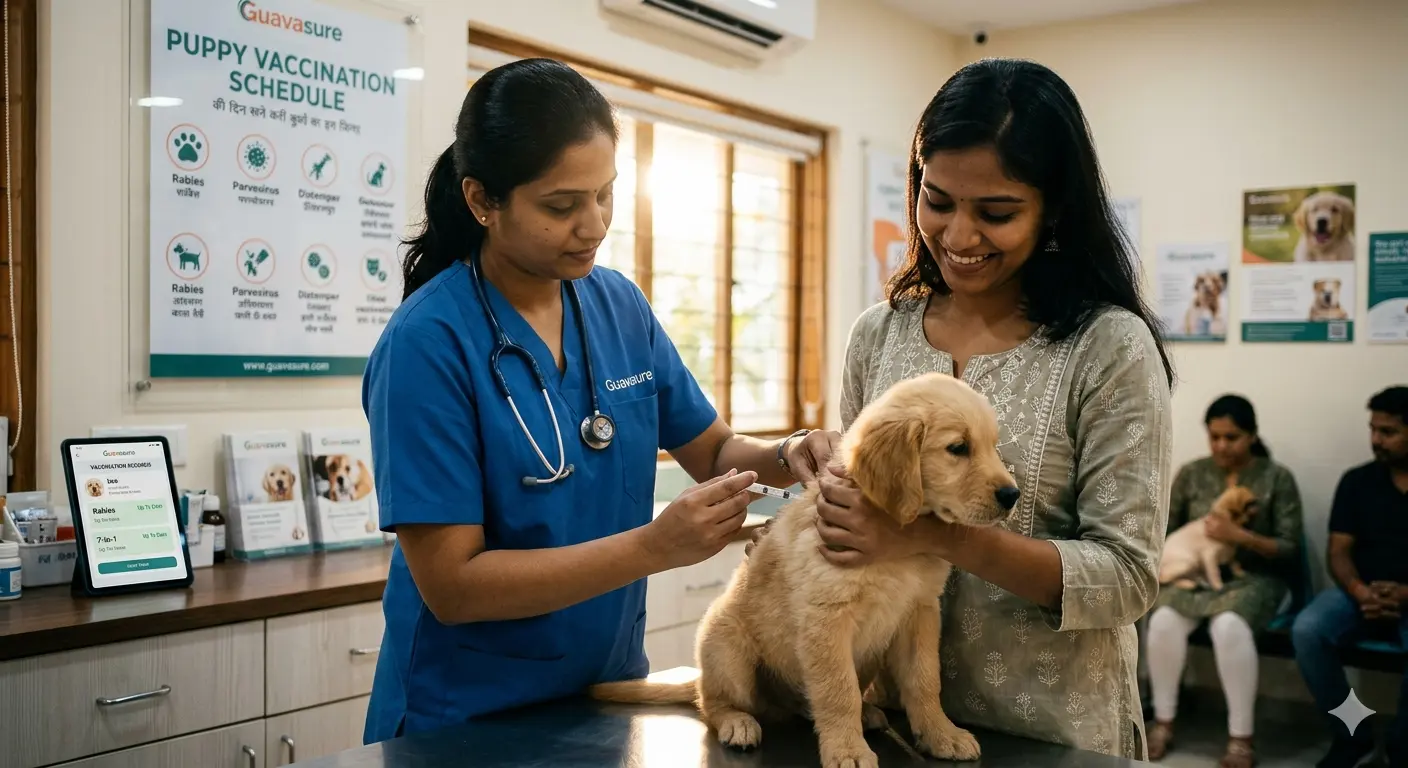
Maternal antibodies from the mother's colostrum protect puppies until 6–8 weeks, then decline unevenly. The three-dose DHPPiL series fills this declining-immunity window. Spacing matters: too close and doses interfere; too far apart and your puppy sits unprotected.
The Indian Veterinary Research Institute (IVRI) recommends completing the full series by 16 weeks, given rabies prevalence across India.
Week 6–8: First DHPPiL Dose
- Maternal antibodies are fading - this primes the immune response
- Your puppy may show mild lethargy for 24–48 hours; this is normal
Week 10–12: Second DHPPiL + First Rabies
- Minimum 3-week gap from dose one
- Rabies is given as a separate injection at a different site
- Post-vaccination monitoring in the clinic (15–20 minutes) is critical
Week 14–16: Third DHPPiL
- Completes the primary immunisation series
- Immunity develops 2–3 weeks post-injection
- Wait 10–14 days before exposing your puppy to public parks or shared water bowls
Week 20–24: Optional Bordetella
- Only if boarding or daycare is planned within 6 months
Month 12–15: First Annual Booster
- All core vaccines repeated exactly 12 months after the final puppy dose
- Timing note: Schedule this booster for March–April to peak immunity before monsoon
The Three Major Vaccine Brands in India: How They Compare
All three use modified-live virus (MLV) technology for distemper, parvo, and parainfluenza, with inactivated bacteria for leptospirosis. The practical differences come down to Leptospira serovar coverage and clinic availability.
| Feature | Nobivac DHPPi+L4 (MSD) | Canigen DHPPi/L (Virbac) | Vanguard Plus 5/L4 (Zoetis) |
|---|---|---|---|
| Lepto serovars | 4 (broader coverage) | 2 (standard coverage) | 4 (broader coverage) |
| Storage | 2–8°C | 2–8°C | 2–8°C |
| Cost/dose | ₹550–800 | ₹400–650 | ₹500–750 |
| Availability | Wide - most metros and tier-2 cities | Wide - strongest in South India | Moderate - mainly metro clinics |
In flood-prone cities (Mumbai, Kolkata, Chennai, Patna, Surat, Kochi), the 4-serovar options (Nobivac L4 or Vanguard L4) justify the ₹100–200 premium per dose - your dog wades through monsoon puddles, and broader coverage pays for itself.
In arid or highland areas (Jodhpur, Shimla, Ooty), the 2-serovar Canigen is adequate and costs less.
Key tip: Ask your vet which brand they stock before the appointment. Switching brands mid-series is safe, but completing all three puppy doses with the same brand gives the cleanest immunisation record.
Track Your Puppy's Vaccinations
Digital health records, automatic reminders & wellness benefits with Guavasure.
Why Timing Your Annual Booster for March Matters
After the puppy series, core vaccines shift to annual frequency in India. While international guidelines allow triennial boosters, Indian vets maintain annual schedules because leptospirosis immunity fades within 12 months and rabies requires consistent coverage.
The single most important scheduling decision: Get your booster in March or April.
Full immunity develops 2–3 weeks post-injection. A March booster means your dog enters the June monsoon with peak leptospirosis protection. Waiting until June leaves a dangerous 2–3 week gap during the highest-risk period.
Your Booster Calendar
- Month 12: First annual booster - DHPPiL + Rabies together, different injection sites
- March–April each year: Optimal timing for DHPPiL to peak before monsoon
- Before boarding: Verify Bordetella was given within the last 6 months
- Age 7+ years: Discuss titre testing with your vet (healthy seniors may tolerate extended intervals for distemper/parvo, but leptospirosis still requires annual protection)
October–November alert: This is a secondary leptospirosis risk window. As floodwater recedes, concentrated bacterial loads remain in drying soil. Pet insurance claims for leptospirosis spike again. If you missed the March booster, schedule it immediately once monsoon ends.
What You'll Actually Pay: City-by-City Breakdown
Vaccination costs depend on three factors: city tier, clinic type, and vaccine brand.
| Service | Metro (Mumbai, Delhi, Bangalore) | Tier-2 (Pune, Ahmedabad, Lucknow) | Tier-3 & Smaller | Government Hospital |
|---|---|---|---|---|
| DHPPiL per dose | ₹600–800 | ₹450–650 | ₹350–500 | ₹50–150 |
| Rabies per dose | ₹300–400 | ₹200–300 | ₹150–250 | Free–₹50 (ABC scheme) |
| Bordetella | ₹600–900 | ₹500–700 | ₹400–600 | Rarely available |
| Consultation fee | ₹400–700 | ₹300–500 | ₹200–350 | ₹20–50 |
| Full puppy series (3× DHPPiL + Rabies) | ₹3,200–4,500 | ₹2,400–3,500 | ₹1,800–2,800 | ₹200–500 |
| Annual booster (DHPPiL + Rabies) | ₹1,200–1,800 | ₹800–1,200 | ₹600–900 | ₹100–250 |
Money-Saving Tips
Clinic chains (Cessna Lifeline in Bangalore, DCC Animal Hospital in Delhi and Mumbai, CGS Hospital in Mumbai) offer bundled puppy packages saving ₹400–800 versus individual appointments.
Government veterinary hospitals offer free or subsidised rabies under the Animal Birth Control programme, though stock consistency varies. Standalone vets quote 15–25% less than chains for the same brands.
What's Normal After Vaccination vs. What Needs a Vet
Expected mild reactions (24–48 hours):
- Lethargy and reduced appetite - normal immune response
- Small firm lump at injection site - resolves in 1–2 weeks
- Slight fever (up to 1°C above normal) - expected on vaccination day
Seek immediate vet care:
- Facial or muzzle swelling within 30 minutes (anaphylaxis)
- Repeated vomiting or diarrhoea within 1 hour
- Injection site lump persisting beyond 3 weeks or increasing in size
Timing tip: Book vaccinations in the morning so you have a full day to monitor your puppy. Avoid late Friday appointments - if a reaction develops overnight, many clinics are closed on Saturday and Sunday.
Anaphylactic reactions are rare (1 in 10,000 doses) but can develop within 5–30 minutes. This is why Indian vets ask you to wait 15–20 minutes in the clinic after the shot.
The Monsoon Leptospirosis Connection: Why Timing Is Everything
Leptospira bacteria thrive in warm, stagnant water contaminated by rat and stray dog urine. India's June–September monsoon turns every low-lying street, construction site, and park into a transmission surface. Dogs contract the disease by wading through puddles or drinking from ground-level pools.
Mumbai, Kolkata, Chennai, and Patna consistently record the highest veterinary leptospirosis case counts each monsoon. Tier-2 cities like Surat, Kochi, and Visakhapatnam see seasonal spikes when drainage systems overflow.
Peak vaccination timing prevents peak risk. A March or April booster means your dog has maximum immunity exactly when leptospirosis transmission peaks.
Protect Your Pet with Guavasure
Wellness benefits, digital ID & insurance access all in one place.
Before Monsoon, Travel, or Boarding: Your Checklist
- Vaccination card photo: Photograph your dog's card and save to cloud storage immediately
- DHPPiL booster status: Confirm it was given within the last 12 months
- March scheduling: If booster is due April–June, move it to March
- Rabies certificate: Verify it's current if booking domestic flights (IndiGo, Air India, SpiceJet all require it)
- Bordetella status: Check if your dog needs it updated for boarding within 6 months
- Interstate travel: Carry the original vaccination card - state border checkpoints occasionally request it during rabies surveillance drives
- Municipal licensing: Most Indian cities require proof of rabies vaccination for dog registration (fees: ₹50–500 depending on municipality)
Protect Your Pet with Guavasure
Wellness benefits, digital ID & insurance access all in one place.
Frequently Asked Questions
Why Vaccination Timing Is Your Superpower
Vaccinations aren't just about preventing disease - they're about preventing expensive emergency visits and heartbreak. In India, where vet costs spike during monsoon season and treatment delays are common, a fully vaccinated dog entering monsoon with peak leptospirosis immunity is your best insurance.
Guavasure tip: Every member on the Guavasure platform gets automatic vaccination reminders and digital health record storage. Your vaccination history is backed up, accessible from anywhere, and updates automatically as you add doses.
Disclaimer: This article provides general information. Always consult your veterinarian for advice specific to your pet's health needs.
Last Updated: March 18, 2026